
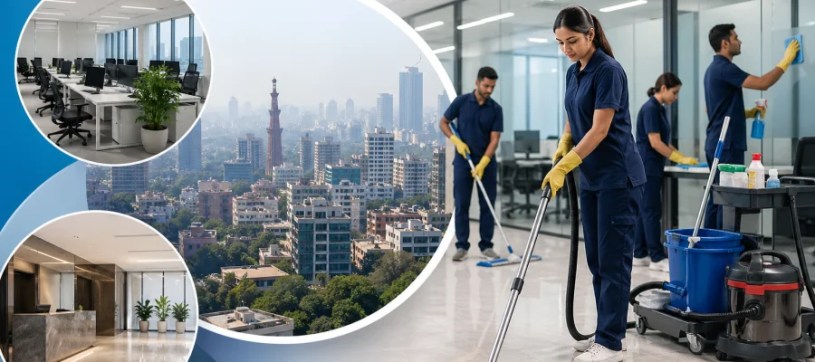
Businesses often approach cleaning as a single purchase, then discover that the contract covering daily office upkeep does not include carpet extraction, high-level dusting or post-renovation clearance. Those are separate services with separate skills, equipment and pricing. Knowing the types of commercial cleaning services that exist makes it possible to build a requirement that covers the whole premises rather than most of it.
Routine Contract Cleaning
This is the backbone: regular attendance at agreed frequencies against a written specification. It covers waste removal, washroom servicing, pantry and kitchen areas, floor care, surface cleaning and touch point disinfection. Frequency follows occupancy, from daily attendance in busy premises to a few days a week in lower-density workplaces. The defining characteristic is consistency the same crew, the same tasks, the same standard, which is what produces a workplace that stays presentable rather than fluctuating.
Periodic Deep Cleaning
Some work cannot sensibly happen daily. Carpet extraction, hard floor stripping and resealing, upholstery cleaning, high-level dusting of light fittings and ledges, internal window cleaning and detailed kitchen work all occur on longer cycles measured in months. These are usually priced separately and scheduled around occupancy. Businesses that assume periodic work is included in a routine contract commonly find, a year in, that surfaces they never thought about have quietly deteriorated.
Carpet and Soft Furnishing Care
Soft surfaces need their own approach because the damage mechanism is abrasion rather than soiling. Methods range from encapsulation for interim maintenance to hot water extraction for restorative cleaning, each with different costs and drying times. A specialist will match the method to fibre type, condition and how quickly the space must return to use a judgement general cleaning crews are not equipped to make.
Industrial and Plant Cleaning
Manufacturing and processing sites need something different in kind. Floor degreasing with industrial machinery, high-level cleaning of structural steel and ductwork, machinery and process equipment cleaning, tank and vessel work, and extraction system cleaning all require specialist equipment, work-at-height capability and often confined space procedures. The driver is safety and equipment reliability rather than appearance, and providers of industrial cleaning services are usually distinct from those serving offices.
Post-Construction and Handover Cleaning
Building work leaves fine dust in every surface, cavity and system, along with adhesive residue, paint splashes and protective film. This is a specialist job usually run in stages a rough clean once trades finish, then a detailed clean, then a final touch-up before handover. Attempting it with routine cleaning resources produces premises that look clean and release construction dust for weeks afterwards, which generates occupant complaints that are difficult to trace.
Specialised Hygiene Environments
Healthcare, laboratories, childcare and food production carry regulated hygiene requirements that go well beyond general cleaning. Colour-coded equipment, validated disinfection protocols with documented contact times, trained staff and auditable records are all standard. Providers working in these settings maintain procedures and training records specifically for them, and a general cleaning contractor stepping into such an environment without that framework creates compliance exposure rather than reducing it.
Washroom and Consumables Services
Often bundled but worth considering separately. This covers servicing frequency, consumables supply and replenishment, sanitary disposal, drain maintenance and odour control. Washrooms disproportionately shape how occupants and visitors judge a building, and they are the most common source of complaints. Specifying frequency and stocking responsibility explicitly, rather than leaving them implicit within a general contract, addresses most of the problems before they arise.
Reactive and Specialist Response
Some requirements cannot be scheduled: flood or water damage clean-up, biohazard response, pest-related cleaning, or emergency response after an incident. Knowing in advance whether your provider can deliver these, and at what response time, matters considerably more at the moment they are needed than during procurement. It is a reasonable question to ask when selecting a commercial cleaning company, even if the service is never used.
Assembling the Right Combination
Few premises need every category, and the useful exercise is mapping requirements against them. An office typically needs routine contract cleaning, periodic carpet and high-level work, washroom services and occasional reactive capability. A factory needs routine cleaning for its administrative areas plus industrial and plant cleaning for production. A retail unit needs frequent routine work with periodic floor care. Working through the list and identifying which categories apply, then confirming which your current arrangement actually covers, usually reveals at least one gap nobody had noticed.
Consolidating Where It Makes Sense
Using one provider across several categories generally improves rates, simplifies scheduling and creates a single point of accountability. The caveat is capability a provider strong in offices may subcontract industrial work, which reintroduces the coordination problem consolidation was meant to solve. Confirming what is delivered directly and what is passed on is the check worth making before signing a broad agreement.
It is worth revisiting the mapping annually rather than treating it as settled. Premises change use, occupancy shifts, equipment is installed and areas are repurposed, and each of those can move a requirement from one category into another. An annual review against the same list takes very little time and catches the gaps before they become the reason for an unplanned deep clean.

